Godot vs Unreal Engine for Solo Devs: The Deadline Secret
Compare Godot vs Unreal Engine for solo devs to evaluate architecture, build times, and productivity so you can ship your indie game on schedule.
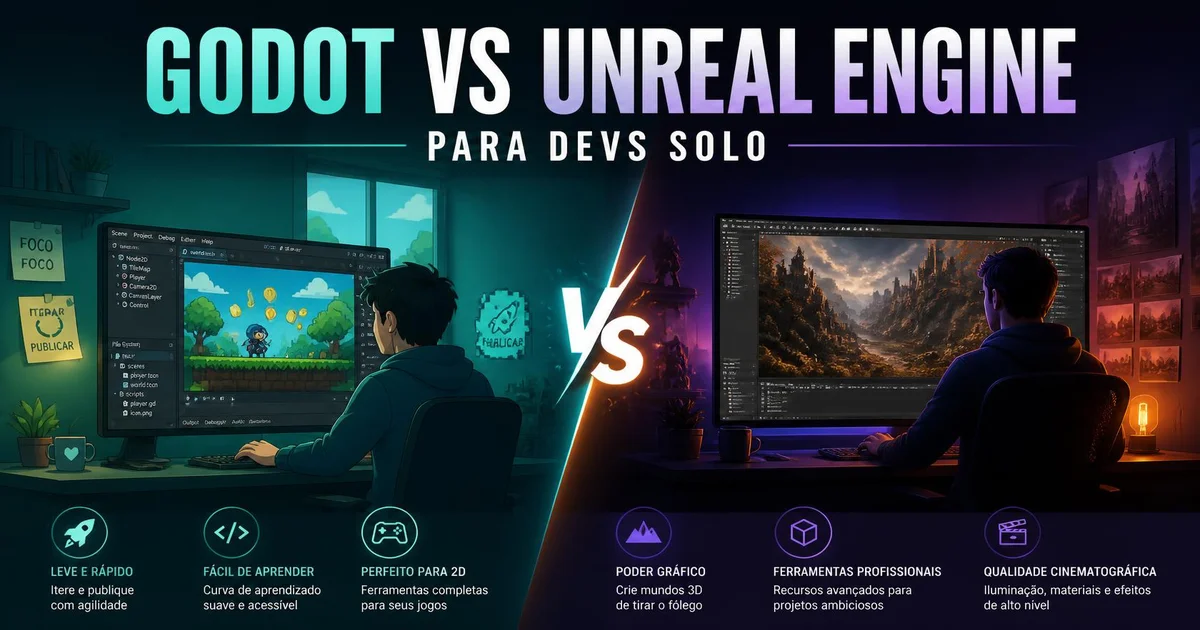
When I decided to build my own games without a support team, I quickly realized that the biggest bottleneck in a solo project isn't artistic talent or a lack of ideas—it's tool friction. Evaluating Godot vs Unreal Engine for solo devs isn't just picking between two popular tools; it's a strategic decision about which software architecture you're willing to carry on your shoulders alone for the next two years. In 2026, with Godot 4.7.2 mature and the tooling ecosystem more demanding than ever, the difference between shipping a game and abandoning it halfway through comes down to iteration speed and how heavily the engine weighs on your daily workflow.
In this article, I do a deep dive into scene architecture, compilation times, language learning curves, and practical productivity for both platforms, strictly from the perspective of a solo developer.
Why Engine Selection Dictates Solo Developer Survival
A solo developer wears every hat at once: programmer, level designer, tech artist, sound designer, and QA tester. When you work alone, every minute spent waiting for shaders to compile or fighting editor crashes is a minute stolen from building the core mechanics of your game.
The survival of a solo indie project relies on radically reducing operational friction. An overly bloated engine introduces hardware bottlenecks and long boot times that destroy your flow state. On the other hand, an engine that's too bare-bones might force you to rewrite complex physics, global illumination, or cloth simulation systems from scratch, wasting months of engineering effort that out-of-the-box tooling could have saved.
The real game-changer is striking the right balance between autonomy and ready-made infrastructure. If a tool requires a dedicated engineering team just to keep project files organized, the solo programmer becomes a slave to engine maintenance instead of focusing on gameplay logic.
How Does Node Architecture Compare to Actor Hierarchy?
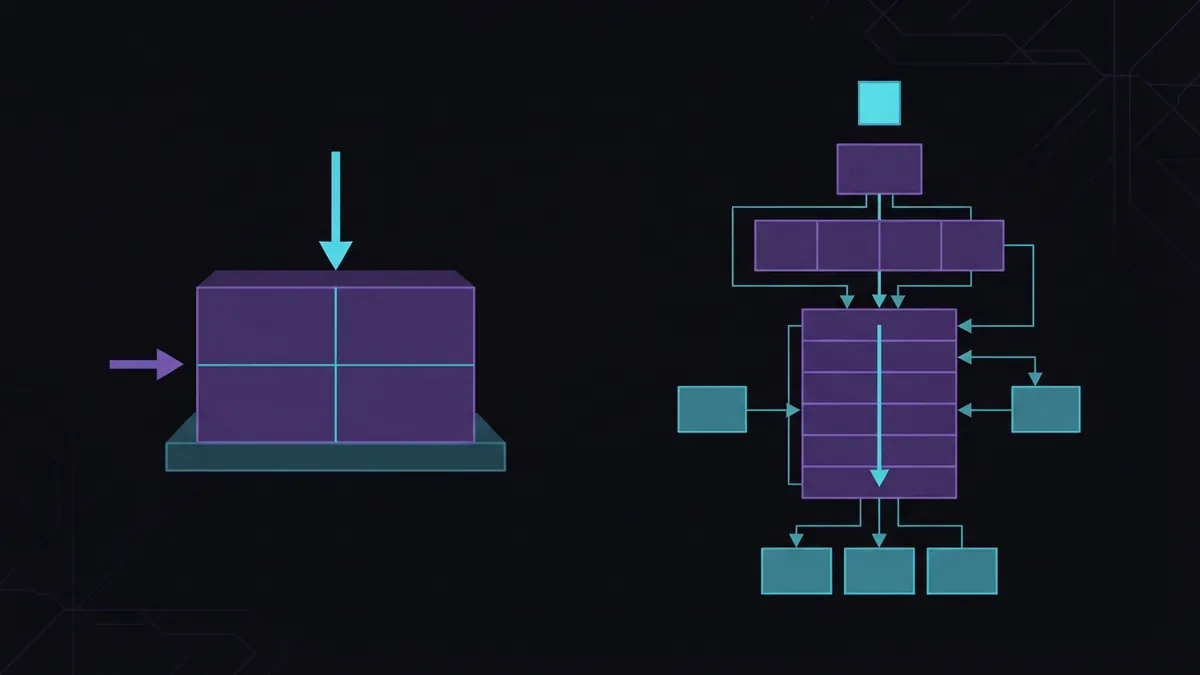
An engine's internal architecture dictates how you structure your code and visual assets. Godot takes a minimalist, orthogonal approach centered around a tree of nodes (Node), where every game element is a reusable scene. Unreal Engine, on the other hand, relies on a component-oriented model encapsulated within Actors (Actor) and Object classes (UObject), optimized for large-scale production.
In Godot 4.7.2, everything is a node. A scene can be a character, a projectile, a UI menu, or an entire level. This symmetry drastically simplifies refactoring for solo projects. If you need to upgrade a static object into a complex interactive element, you simply save that node as a new scene and extend it without breaking references across the rest of the project.
# Simple node extension example in GDScript (Godot 4.7.2)
extends CharacterBody2D

@export var move_speed: float = 300.0
@export var jump_impulse: float = -400.0

var gravity: float = ProjectSettings.get_setting("physics/2d/default_gravity")

func _physics_process(delta: float) -> void:
    if not is_on_floor():
        velocity.y += gravity * delta

    if Input.is_action_just_pressed("ui_accept") and is_on_floor():
        velocity.y = jump_impulse

    var direction := Input.get_axis("ui_left", "ui_right")
    velocity.x = direction * move_speed
    move_and_slide()
In Unreal Engine, the architecture stems from AAA industry standards. A playable character isn't just a node—it's an instance of the ACharacter class, pre-packed with movement components (UCharacterMovementComponent), collision capsules, and skeletal meshes. The upside is that complex features like networked movement, slope walking, and character physics work immediately. The downside for a solo dev is tight coupling: modifying default behavior requires navigating a massive class hierarchy.
What Is the Impact of GDScript vs. C++ and Blueprints on Productivity?
Daily iteration speed in solo development depends directly on how long it takes to edit a line of code and see the result on screen. Godot primarily uses GDScript, a dynamically typed language (with optional static typing) whose syntax mirrors Python 3.14.7. GDScript was custom-built to integrate into the engine's execution loop, enabling hot reloading without requiring full re-compiles.
For a solo developer, tweaking code parameters and testing the scene in under two seconds delivers unbeatable prototyping speed. Beyond GDScript, Godot offers native C# support, serving developers who need higher computational performance for heavy numerical simulations.
In Unreal Engine, development is split between Blueprints (a node-based visual scripting language) and C++. Blueprints are incredibly powerful for rapid prototyping and UI logic, letting you build complete systems without writing text-based code. However, as a solo project grows, overly dense Blueprint graphs become difficult to maintain and refactor without meticulous documentation.
// Example of a custom C++ component in Unreal Engine
#include "CoreMinimal.h"
#include "Components/ActorComponent.h"
#include "HealthComponent.generated.h"

UCLASS(ClassGroup=(Custom), meta=(BlueprintSpawnableComponent))
class GAME_API UHealthComponent : public UActorComponent
{
    GENERATED_BODY()

public:
    UHealthComponent();

protected:
    virtual void BeginPlay() override;

public:
    UPROPERTY(EditAnywhere, BlueprintReadWrite, Category = "Health")
    float MaxHealth = 100.0f;

    UPROPERTY(VisibleAnywhere, BlueprintReadOnly, Category = "Health")
    float CurrentHealth;

    UFUNCTION(BlueprintCallable, Category = "Health")
    void TakeDamage(float DamageAmount);
};
When logic requires C++ in Unreal Engine for performance optimization, solo developers bear the compilation cost of native code. Even with Live Coding, recompile times and the overhead of Unreal's reflection macros (UCLASS, UPROPERTY, UFUNCTION) create a steep learning curve that slows down the daily fine-tuning cycle.
How Do Footprint Size and Memory Consumption Affect Hardware?
Project footprint on disk and RAM consumption are frequently overlooked during initial planning. Godot 4.7.2's editor executable is under 100 MB and requires no formal installation, running directly from a single binary. The project launches in seconds, and idle RAM usage rarely exceeds 500 MB. This lets a solo developer work comfortably on mid-range laptops or modest workstations.
Conversely, a standard Unreal Engine installation can easily top 100 GB of storage, demanding high-end GPUs and at least 32 GB of RAM for a stutter-free editing experience during shader compilation and lighting bakes. For solo developers importing Blender 5.2.1 models, Unreal Engine provides high-fidelity automated imports via Datasmith, along with Nanite tech for high-density geometry without manual LOD creation.
While Unreal Engine's Nanite and Lumen global illumination deliver stunning visuals out of the box, they force the solo dev to act as a performance optimizer to ensure the game runs smoothly on target players' GPUs. In Godot 4.7.2, the Vulkan rendering pipeline and Forward+ renderer deliver great visual quality for 2D and mid-sized 3D games without overwhelming the developer's hardware.
How Do You Align Technical Criteria in a Comparison Table?
Below is a detailed technical comparison of key features between both engines from a solo developer's perspective:
| Evaluation Criterion | Godot 4.7.2 | Unreal Engine |
|---|---|---|
| Installation Size | ~100 MB (no external dependencies) | >100 GB (full installation) |
| Primary Language | GDScript / C# | Blueprints / C++ with macros |
| Editor Boot Time | 2 to 5 seconds | 30 to 90 seconds |
| Learning Curve | Low to Medium | High to Very High |
| Native 2D Support | Exceptional (dedicated 2D engine) | Limited (basic Paper2D support) |
| Advanced 3D Rendering | Very Good (Forward+ / Vulkan) | Photorealistic (Nanite, Lumen) |
| Licensing and Cost | 100% Free & Open Source (MIT) | Free up to $1M (5% royalty after) |
| Builds and Export | Lightweight builds & fast export | Heavy packages & large binaries |
How Should You Choose Between Godot vs Unreal Engine for Solo Devs?
The bottom line comes down to visual scope, available time, and your hardware setup. There is no universally superior engine; there is only the right tool for the project scale you can actually complete without giving up halfway.
You should choose Godot if your focus is to:
- Develop 2D games of any complexity (platformers, retro RPGs, top-down strategy).
- Create 3D games with a strong stylized art direction or moderate rendering scope.
- Maintain ultra-fast prototyping cycles with GDScript and instant editor startup.
- Retain full ownership of your source code with zero licensing fees or corporate contracts.
- Work on hardware without high-end graphics cards without sacrificing performance.
On the flip side, picking Unreal Engine makes sense when:
- Your game's main selling point is cutting-edge, photorealistic 3D visuals.
- Your gameplay heavily relies on complex vehicle physics, environment destruction, or dynamic open-world global illumination.
- You are comfortable with or want to specialize in Blueprint visual scripting and corporate C++ architecture.
- You own a high-end workstation capable of handling massive shader compiles and multi-gigabyte project folders.
For solo developers, the ultimate trap is picking Unreal Engine solely because of glossy stock demo reels, ignoring the massive amount of work required to produce assets at that fidelity without a team of artists backing you up.
Conclusion
Evaluating Godot vs Unreal Engine for solo devs reveals that technical productivity is the single biggest factor in turning an idea into a published game. Godot 4.7.2's lightweight, modular architecture offers an environment where iteration is nearly instant, allowing a solo developer to build, test, and refine systems without breaking stride. Meanwhile, Unreal Engine offers an unmatched technological foundation for photorealistic 3D, demanding greater architectural discipline and serious compute power in return.
When planning your next title, evaluate your time constraints and hardware budget honestly. Choosing the tool that minimizes friction in your daily workflow is the single best move you can make to ensure your game reaches the finish line.