Pydantic AI vs LangChain: Which Should You Pick in 2026?
Deciding between Pydantic AI vs LangChain in 2026? Compare architecture, typing, and performance in Python 3.14.7 to pick the right AI framework.
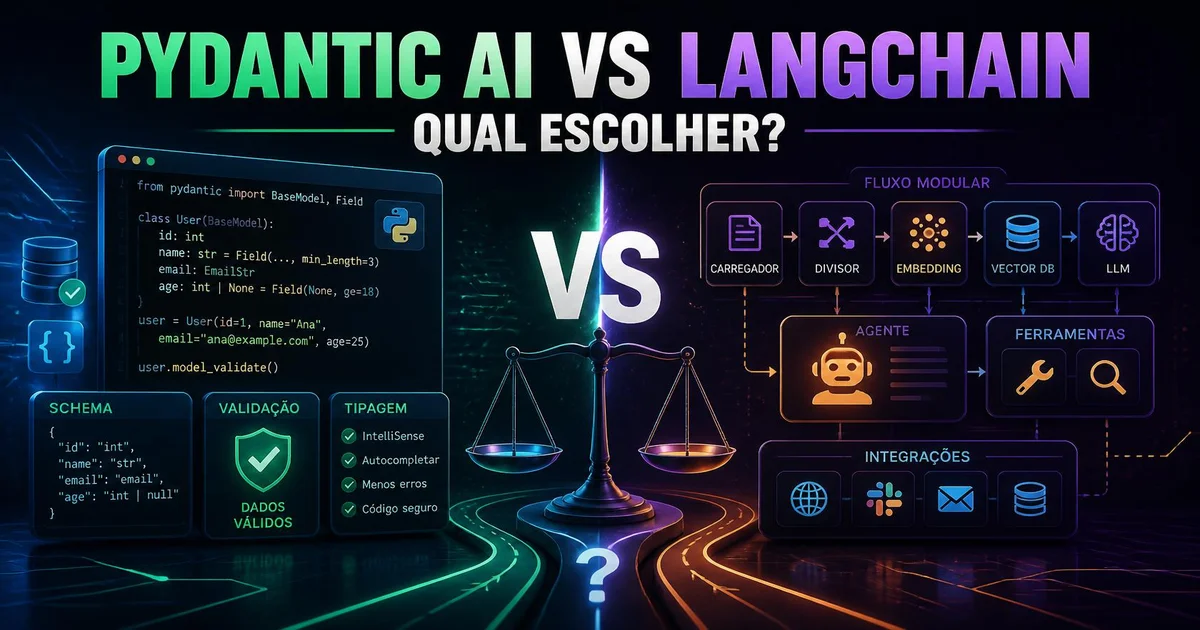
The AI-driven software development ecosystem has undergone a profound transformation over the last few years. Where the industry standard for orchestrating LLM calls once relied on high-level abstractions packed with hidden layers, today's push for predictability and low latency has shifted the paradigm. When comparing pydantic ai vs langchain side by side, the choice moves beyond syntax preference—it becomes a critical software architecture decision that directly impacts code maintainability, debugging speed, and integration with modern Python 3.14.7 production environments.
Historically, LangChain dominated the early phases of the LLM boom by offering out-of-the-box connectors for virtually every vector database and API on the market. However, that convenience came at the cost of heavy abstraction overhead, brittle chains, and recurring headaches when tracing runtime errors. Conversely, Pydantic AI entered the AI landscape with the same design philosophy that made FastAPI a staple: strict static typing, native data validation within the execution loop, and direct reliance on Pydantic V2, enabling engineers to build agents with granular control over data flow.
What Changed in the Python AI Agent Ecosystem?

In the early days of integrating large language models into enterprise apps, the main bottleneck was a lack of standardization between the model and external systems. LangChain solved that initial problem by wrapping prompt construction, response parsing, and tool execution inside concepts like Chains and Agents. But as systems evolved into mission-critical microservices, developers ran into severe maintainability bottlenecks. Deep abstraction stacks made call tracing convoluted, where a simple JSON validation failure from an API response resulted in cryptic, generic exceptions that were painful to debug.
With function calling specifications maturing and the modern Python 3.14.7 ecosystem taking hold, engineering focus shifted from quick prototyping to production reliability. Schema validation stopped being a post-processing step after the model API call and became the backbone of the application. Pydantic AI emerged right at this intersection: instead of wrapping your infrastructure in custom abstractions, it uses Pydantic's structured validation to guarantee that every input, output, and tool call adheres to strict type contracts compiled in native code.
This conceptual shift reflects a clear trend across engineering teams: senior developers favor explicit tools that integrate seamlessly with Python's native type system and standard static analysis tooling like Mypy and Pyright, over monolithic frameworks that impose proprietary internal data structures.
How Do You Compare Pydantic AI vs LangChain Architecturally?
The core difference between these two options lies in their design philosophy and the level of control exposed to the developer. LangChain takes a batteries-included, all-encompassing approach, trying to cover every imaginable scenario using specialized modules like LangChain Core, LangGraph, and LangSmith. While this layered architecture lets you build complex state graphs, it requires learning a massive custom API and managing internal objects like HumanMessage, AIMessage, and PromptTemplate.
Pydantic AI, on the other hand, was built from the ground up around dependency injection and native Python typing. Instead of requiring custom message schemas and proprietary connectors, it treats the agent as a standard Python object configured via Pydantic models. Generic Python types define the expected model output, and the framework automatically retries calls if the LLM response violates the target schema. Validation happens in real time during generation or parsing, leveraging the raw speed of Pydantic V2's Rust core.
The table below summarizes the key technical criteria when evaluating pydantic ai vs langchain for enterprise production:
| Technical Criterion | LangChain | Pydantic AI |
|---|---|---|
| Design Philosophy | All-encompassing framework built around graphs and chains | Lean library focused on strict typing and validation |
| Schema Validation | Adapter layer coupled to framework output parsers | Native, first-class integration powered by Pydantic V2 |
| Dependency Injection | Manual state passing or graph context management | Native, strongly-typed injection in the agent handler |
| Learning Curve | Steep, due to a vast array of custom abstractions | Gentle for developers fluent in idiomatic Python and FastAPI |
| Debugging Ease | Complex in deep chains without LangSmith telemetry | Straightforward, with direct Python language stack traces |
| Import Performance | High overhead loading numerous modules and cross-deps | Lightweight, instant startup with minimal memory overhead |
While LangChain excels when you need to plug into dozens of legacy integrations instantly without building custom adapters, Pydantic AI provides a far sturdier foundation for microservice architectures where data predictability is a non-negotiable requirement.
How Does Simple Agent Code Look in Both Tools?
To see how these architectural decisions play out in daily development, let's look at how an agent with tool-calling capabilities and structured outputs is implemented in both platforms. The objective of the code below is to fetch an order status from an internal database and return a strictly validated response.
First, here is a typical LangChain approach, requiring model configuration, tool definitions via specialized decorators, and execution setup using a structured agent executor:
from langchain_core.tools import tool
from langchain_openai import ChatOpenAI
from langchain.agents import AgentExecutor, create_tool_calling_agent
from langchain_core.prompts import ChatPromptTemplate, MessagesPlaceholder
from pydantic import BaseModel, Field

class StatusPedido(BaseModel):
    id_pedido: str = Field(description="Identificador unico do pedido")
    status: str = Field(description="Estado atual do processamento")
    dias_entrega: int = Field(description="Prazo estimado em dias")

@tool
def buscar_status_sistema(id_pedido: str) -> dict:
    """Consulta o banco de dados interno para obter dados do pedido."""
    # Database query simulation
    return {"id_pedido": id_pedido, "status": "em_transito", "dias_entrega": 3}

llm = ChatOpenAI(model="gpt-4o-mini", temperature=0)
tools = [buscar_status_sistema]

prompt = ChatPromptTemplate.from_messages([
    ("system", "Voce e um assistente de suporte logistico eficiente."),
    ("human", "{input}"),
    MessagesPlaceholder(variable_name="agent_scratchpad"),
])

agente = create_tool_calling_agent(llm, tools, prompt)
executor = AgentExecutor(agent_agent=agente, tools=tools, verbose=False)

resposta = executor.invoke({"input": "Qual o status do pedido PED-9942?"})
print(resposta["output"])
Notice that in the LangChain example, tying tools, prompts, and execution handlers together requires instantiating an AgentExecutor while passing inputs and outputs as generic dictionaries, stripping away static type checks on the final response returned to the caller.
Now, see how the exact same functionality is implemented using Pydantic AI in Python 3.14.7, leveraging generic typing to define structured output directly in the agent signature:
from dataclasses import dataclass
from pydantic import BaseModel, Field
from pydantic_ai import Agent, RunContext

class StatusPedido(BaseModel):
    id_pedido: str = Field(description="Identificador unico do pedido")
    status: str = Field(description="Estado atual do processamento")
    dias_entrega: int = Field(description="Prazo estimado em dias")

@dataclass
class DependenciasConexao:
    url_banco: str

agente = Agent[
    DependenciasConexao, StatusPedido
](
    "openai:gpt-4o-mini",
    result_type=StatusPedido,
    system_prompt="Voce e um assistente de suporte logistico eficiente.",
)

@agente.tool
async def buscar_status_sistema(ctx: RunContext[DependenciasConexao], id_pedido: str) -> dict:
    """Consulta o banco de dados interno para obter dados do pedido."""
    # Safe access to injected dependencies via typed context
    _ = ctx.deps.url_banco
    return {"id_pedido": id_pedido, "status": "em_transito", "dias_entrega": 3}

deps = DependenciasConexao(url_banco="postgresql://localhost:5432/logistica")
resultado = agente.run_sync("Qual o status do pedido PED-9942?", deps=deps)

# The result is a validated StatusPedido instance with full IDE support
status_final: StatusPedido = resultado.data
print(f"Pedido {status_final.id_pedido}: {status_final.status} (Prazo: {status_final.dias_entrega} dias)")
This visual code comparison highlights the practical difference: Pydantic AI treats the LLM response as a guaranteed type (StatusPedido). If the model returns an invalid field, Pydantic AI rejects the response and can automatically trigger a retry prompt detailing the validation error, without requiring you to write custom exception handlers.
What Is the Memory Consumption and Latency of Each Framework?
In high-throughput production environments, microservice cold-start times and RAM footprints directly impact infrastructure costs. LangChain, due to its massive ecosystem of sub-packages and integrations, carries a heavy dependency tree. Importing LangChain's core package into a serverless function or containerized service can add hundreds of milliseconds purely during module loading.
By contrast, Pydantic AI takes full advantage of Pydantic V2's Rust-optimized core. Type validation and JSON payload parsing for provider APIs (like OpenAI, Anthropic, or local models running via Ollama) execute with compiled native code speed. This results in a significantly lower memory footprint and latency profiles where network round-trips to the LLM are the only bottleneck, eliminating internal framework overhead.
Concurrency management is another critical performance factor. Pydantic AI was engineered from day one around modern Python async patterns (async/await). While LangChain retrofitted async support onto a legacy synchronous core, Pydantic AI provides native asynchronous execution out of the box, making it easy to chain agents and run parallel tool calls without blocking the application event loop.
When it comes to observability, both frameworks offer call tracing. LangChain integrates natively with its proprietary platform, LangSmith, which requires account setup and API key management for full functionality. Pydantic AI embraces open standards like OpenTelemetry via Pydantic Logfire, allowing you to export execution traces directly to any APM or monitoring vendor (such as Datadog, Grafana, or OpenTelemetry Collector) without vendor lock-in.
What Is the Best Choice for Your Project in 2026?

Choosing between these technologies comes down to project scope and team maturity. Neither tool is a silver bullet, and understanding where each excels helps prevent costly refactoring later on.
Choose LangChain when:
- You are rapid-prototyping applications that need to plug into dozens of heterogeneous data sources and vector databases with pre-built LangChain Community connectors.
- Your project requires complex, non-linear state flows and graph architectures via the LangGraph ecosystem, leveraging built-in state persistence.
- Your team already relies on established infrastructure built around LangSmith to trace and monitor prompts at scale.
Choose Pydantic AI when:
- You are engineering production microservices in Python 3.14.7 where static typing, schema enforcement, and codebase reliability are top priorities.
- Your stack already makes extensive use of Pydantic and FastAPI, letting you reuse database models and HTTP schemas directly in AI agent definitions.
- Keeping code clean, easy to unit-test with
pytest, and free from heavy vendor-specific abstractions is essential. - Low resource consumption, fast container cold starts, and open observability standards matter to your architecture.
Conclusion
The evolution of AI developer tooling marks a transition from rapid experimentation to disciplined software engineering. In this comparative breakdown of pydantic ai vs langchain, it is evident that the industry is favoring lighter, transparent, and strongly typed abstractions. While LangChain remains a powerful suite for exploring complex graph workflows with an extensive plugin library, Pydantic AI sets a new standard for clean, predictable architecture in modern Python microservices. Evaluating your project's architectural complexity and type safety requirements will guide you toward the right long-term choice.