DeepSeek-R1 vs Llama 3.3: Which to Choose in 2026?
Compare architecture, VRAM usage, and inference performance in DeepSeek-R1 vs Llama 3.3 to choose the right open-weights LLM for your local GPU server.

Running large language models locally has evolved from an experimental setup into a core security and cost requirement for software engineering teams. When comparing deepseek-r1 vs llama 3.3, developers and solution architects encounter two opposing AI philosophies: on one side, a long chain-of-thought reasoning approach optimized via reinforcement learning; on the other, a dense model refined for fast, direct instruction following.
Executing these models on local servers within Python 3.14.7 environments requires understanding GPU memory constraints, throughput behavior, time-to-first-token (TTFT) latency, and the response patterns enterprise applications expect. This article breaks down both models in real-world local inference scenarios, assessing infrastructure overhead, resource consumption, and practical trade-offs.
Why Has Local Model Selection Changed in 2026?
Until recently, choosing an open-weights model for local inference boiled down to raw parameter count and context window length. In 2026, the rise of specialized reasoning models fundamentally changed the inference pipeline. Models like DeepSeek-R1 do not simply return an instant response; they allocate compute during inference to explore hypotheses, test logical paths, and self-correct before producing final text.
Conversely, 70B dense models like Meta's Llama 3.3 stick to traditional high-density, direct-response architectures. They excel at rapid generation, robust multilingual instruction following, and strict adherence to structured tool calls (function calling). Picking the wrong tool for your pipeline can lead to unnecessary hardware costs or latency spikes that degrade user experience.
How to Compare DeepSeek-R1 vs Llama 3.3 on Local Servers?
To fairly evaluate both options, you need to look past generic benchmarks and examine infrastructure engineering metrics and real-world developer workflows. Running models in production under modern inference engines like vLLM and Ollama exposes clear operational differences.
| Evaluation Criteria | DeepSeek-R1 (671B / Distillations) | Meta Llama 3.3 (70B) |
|---|---|---|
| Primary Architecture | Mixture of Experts (MoE) / Chain-of-Thought | Dense Transformer |
| Optimization Focus | Mathematical reasoning, logic, and complex coding | General instruction following, summarization, and JSON formatting |
| Typical VRAM Usage | Variable (37B active in full / 5.2GB to 43GB in distilled variants) | ~40GB to 48GB (quantized in FP8/INT4) |
| Output Behavior | Generates <think> block prior to final output |
Direct and immediate response to prompt |
| Function Calling Support | Moderate (requires parsing chain-of-thought outputs) | Excellent and natively fine-tuned |
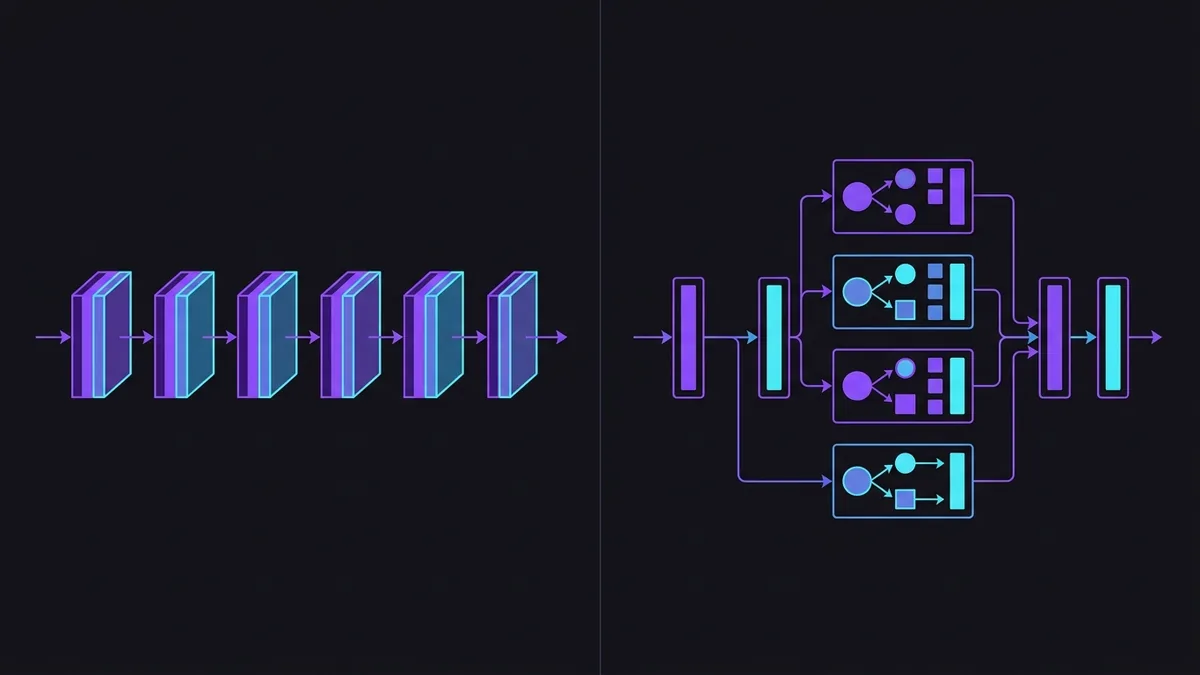
The main distinction lies in how tokens are processed. While Llama 3.3 activates all 70 billion parameters for every generated token, the flagship DeepSeek-R1 model employs a Mixture of Experts (MoE) architecture with 671B total parameters, activating only 37B per token. For resource-constrained hardware, distilled versions of DeepSeek-R1 (built on Llama and Qwen bases ranging from 8B to 70B) bring chain-of-thought reasoning to entry-level and mid-range GPUs.
What Is the Architectural Difference Between R1 and Llama 3.3?
Llama 3.3 70B represents the state of the art for conventional dense Transformers. Every network layer processes incoming vectors through all attention and feed-forward matrices. This produces highly predictable per-token processing times, simplifying concurrent workload scaling on clusters running vLLM.
Full DeepSeek-R1 uses dynamic routing to direct data through specialized expert sub-networks. Furthermore, its large-scale reinforcement learning training without direct human supervision unlocks intrinsic self-reflection. In practice, when tasked with a complex coding challenge, the model generates an internal reasoning sequence enclosed in a <think> tag:
<think>
The user asked for a Python function to solve the traveling salesperson problem using dynamic programming.
First, I need to check memory constraints for N <= 16.
The bitmask approach O(N^2 * 2^N) is appropriate.
I should make sure the return type is explicitly typed using Python 3.14 type hints.
</think>

def tsp_dp(graph: list[list[int]]) -> int:
    ...
This deliberation step increases the total token count per request. If your application bills per output token or handles synchronous HTTP requests with tight timeouts, reasoning models can trigger timeout errors unless your pipeline parameters are properly tuned.
How to Measure VRAM Usage and Performance in Python?
When integrating LLMs into modern Python stacks, your choice of inference engine determines memory efficiency. vLLM provides advanced support for PagedAttention and Prefix Caching, which are critical for context reuse in long conversations.
Here is a practical Python 3.14 inference server script using the unified vLLM/OpenAI client to load and evaluate model responses:
```python rest_client.py import asyncio from openai import AsyncOpenAI
Client pointing to local vLLM / Ollama instance
client = AsyncOpenAI( base_url="http://localhost:8000/v1", api_key="ollama-local" )
async def test_inference(model_name: str, prompt: str) -> None: print(f"--- Testing model: {model_name} ---") response = await client.chat.completions.create( model=model_name, messages=[ {"role": "system", "content": "You are a senior Python software engineer technical assistant."}, {"role": "user", "content": prompt} ], temperature=0.6 )
content = response.choices[0].message.content
print(content)
async def main(): prompt = "Write a Python 3.14 class using dataclasses to manage a concurrent queue with asyncio."
# Comparing reasoning model vs traditional dense model
await test_inference("deepseek-r1:8b", prompt)
await test_inference("llama3.3:70b", prompt)
if name == "main": asyncio.run(main()) ```
Running this script demonstrates that deepseek-r1:8b consumes roughly 5.2 GB of VRAM at 4-bit quantization, making it viable on consumer GPUs like an RTX 4060 or 5060. However, total response latency may be higher due to output tokens generated inside the reflection block.
On the other hand, llama3.3:70b requires at least 40 GB to 48 GB of VRAM to run under INT4/FP8 quantization on enterprise GPUs (such as an A100/H100 or dual NVLink-connected RTX 3090/4090 GPUs). Time-to-first-token is lower, and output text streams immediately without <think> block overhead.
Which Option Is Best for Automation Pipelines and RAG?
In Retrieval-Augmented Generation (RAG) architectures and autonomous agent systems, how a model handles noisy context determines system stability.
Use Llama 3.3 when:
- Your pipeline strictly relies on native JSON formatting to integrate with REST APIs or PostgreSQL 18.6 databases.
- The workload focuses on real-time information extraction, document summarization, or interactive customer support.
- You have sufficient hardware budget to host 70B parameter models.
Use DeepSeek-R1 (or its Distill variants) when:
- Your application solves math problems, performs complex static code analysis, or handles software architecture refactoring.
- Logical accuracy and depth take priority over initial token latency.
- Local hardware is limited, requiring efficient 8B or 14B distilled models with high analytical capabilities.
What Is the Practical Verdict for Your Tech Stack?
Choosing between these models does not have to be an either-or decision for modern enterprise infrastructure. Many engineering teams deploy a hybrid routing layer: simple queries and tool calls get routed to Llama 3.3, while deep debugging, security audits, and complex algorithm generation get sent to DeepSeek-R1.
When planning your local server deployment in 2026, keep GPU drivers updated and leverage vLLM's dynamic adapter loading to maximize hardware utilization.
Conclusion
Choosing the winner in deepseek-r1 vs llama 3.3 depends entirely on the nature of your computational workload. Llama 3.3 remains the benchmark for versatility, instruction follow-through, and speed in traditional enterprise workflows. Meanwhile, DeepSeek-R1 redefines local analytical intelligence, enabling smaller models to deliver reasoning capabilities that were previously locked behind expensive proprietary APIs. Evaluate your available VRAM, benchmark your latency tolerance, and deploy the model that best balances operational cost with technical precision.